

I shared this discovery with one of my brothers and he commented, “Wow! I share many of the Quaker beliefs!”
Did my brother inherit a “Quaker” gene?
Because Isaac joined a militia, he was disowned from the Quaker faith in January, 1757. Similarly, members and leaders in my protestant church readily shared their disapproval of my military service because I was a wife and mother. They believed women should be “helpers” while I strongly believed in being a conscientious protector. Due to this spiritual difference, I “disowned” myself from that church.
 |
| U.S., Quaker Meeting records,1681-1935 Pennsylvania; Berks; Exeter Monthly Meeting |
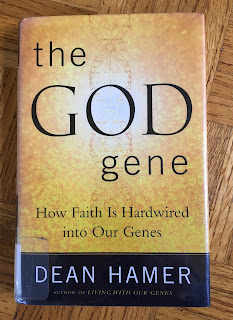
First, it is important to differentiate between spirituality and religion. According to Dean Hamer, author of “The God Gene: How Faith is Hardwired into Our Genes”, there is “a sharp distinction between spirituality, which is a personality trait that some of us have to a greater or lesser extent than others, and religion, which is a culturally transmitted expression of spirituality.”
In his book, Hamer contends that one's predisposition toward spirituality is influenced by genetic factors. More controversially, he proposes that the VMAT2 gene is one of many potential genes that influence spirituality. Hamer identifies one particular variation, a change from an A to a C, present in 28% of the alleles in his data set, as a marker for the more “spiritual” version of this gene.Among the skeptics of Hamer’s work was John Polkinghorne (1930-2021) an English theoretical physicist, theologian, and Anglican priest. Commenting on “The God Gene” for The Daily Telegraph, he said "The idea of a God gene goes against all my personal theological convictions. You can't cut faith down to the lowest common denominator of genetic survival. It shows the poverty of reductionist thinking."
 |
| spectrumagazine.org |
 |
| csail.mit.edu |
It might be that some variation in personal spirituality is explained by genetics, although spirituality is a complex trait influenced by many genes as well as upbringing and culture. Genetics probably play a small part, but we could surely benefit from at least some understanding of that small part.
All of this seems to suggest that there might be:
- good reason to view spirituality as another part of the rich genetic and cultural variety that makes us human,
- and an even better reason to learn to respect and enjoy the full range of that variety.


