Saturday, May 7, 2022

The Finish Line


Years after his Olympic appearances, Frank Shorter, a gold and silver medalist marathoner, ran a race in Seattle. He finished out of the top 20 runners. As he was preparing to leave, another runner approached him. “Hey, aren’t you Frank Shorter?”

To which Frank replied, “No … but I used to be.”

Frank’s “glory days” are over, he will never cross an Olympic finish line again. Instead Frank is successfully crossing a new finish line – Race4Kids’ Health. Frank uses his experiences as a runner and as a victim of child abuse to connect children with the power of health. He explains, “What I’m trying to do through my work with Healthy Learning Paths, is to show kids how to use healthy habits like good diet and exercise to better their social and emotional health and their resiliency—to run toward a solution and not just away from a problem.”

We – like Frank - will grow old and slow and our finish lines will change. But there is one finish line everyone must cross. Loved ones will die and, in our own time and in our own way, we, too, will cross life’s finish line. How will we choose to experience it?

Runner Dr. George Sheehan was diagnosed with metastatic prostate cancer in 1986. In January 1993 he learned that his hormone treatment was no longer working, the cancer had gone into “fast forward”. George then needed radiation just to control the pain. At that time he was still ambulatory but could no longer run. He said, “My mission now is to deal with cancer, its therapy, and all the implications, and tell others what it is like.”

Success for George shifted from running to becoming the best George he could be. He chose to continue his search for meaning and truth, asking – “After I die, what?” which led to “Before I die, what?” He continued writing and reading extensively while he explored Quakerism, philosophy, and discovered anthropology. Two months before he died, George registered for a college-level anthropology course.

His running days were over but he made the best of his situation through reading, exploring new ideas and writing about his experience. George’s attitude towards his situation embodied the words of Holocaust survivor, Dr. Viktor Frankl, “Any man can, even under such circumstances, decide what shall become of him – mentally and spiritually.”

On November 1, 1993 George successfully crossed his finish line.

“In giving me cancer, fortune had smiled on me. Pain was key to opening up to a new and larger life. The interests of my past are still present, but now finally seen in perspective.”- Dr. George Sheehan
 
Perhaps more difficult than facing our own death, is dealing with the death of a loved one. Often we have to make decisions for someone who is unable to decide for themselves how and when they will cross their finish line. 

In 2003, my father was not feeling well and was admitted to the hospital. During phone calls with my mother, she insisted he was “fine.” Fortunately, my older sister called me to tell me Dad was not “fine” – he was dying.

I flew from Virginia to Illinois and went with my mother to the hospital. Dad was not responsive, he would occasionally open his eyes but only stared at the ceiling. I don’t know if he even knew I was there. No matter how much my mother wanted him to be “fine,” or how often the nurses checked him or gave him medication through his IV, Dad was not going to “get better.”

Mom and I sat in the room with him, talking as if he was “fine.” Then, as I drove her home at the end of the day, I told her I wanted to call my siblings to let them know they should come and see Dad because I thought he was nearing the finish line. “No!” she shouted, “He’s going to be fine!”

The next day we were sitting with Dad when his doctor asked us to meet with him in a consultation room. “We need to know if you want a do-not-resuscitate order,” he said.

Mom immediately said, “No!” Then she began sobbing. “I don’t want to fail him, we have to keep him alive.”

Patiently, and with precise details, his doctor explained exactly what would happen if the nurses attempted to resuscitate Dad.

I asked, “If you successfully resuscitate Dad, what then? Will his health be restored?”

“No.” the doctor answered, “We will just be prolonging the dying process.” He then explained Dad’s deteriorating physical condition. They had done all they could.

“Do not resuscitate,” I said. I looked at Mom and, through her tears, she nodded her agreement. Then I began calling my siblings.

Dad crossed his finish line on March 19, 2003 with several of his children at his bedside, holding his hands.

We did “the best” we could for Dad. The decision not-to-resuscitate due to his physical condition was informed and made in consultation with his doctor. Then we surrounded Dad with as much love as possible as he crossed his finish line. “The best” we could do for ourselves was to choose to be in control of our attitude towards our father’s death.

Dealing with death shifts the terms of success. “The best” often is not what we may want, nor wish for, and it can be extremely painful. In the worst situations our attitude may be the only thing we can control while in better situations we have more options from which to choose.

Many challenges will confront us as we move closer to our finish line. We will not always be healthy, we will grow old, we will experience the death of loved ones and, ultimately, our own turn to cross life’s finish line.  Regardless of the situation, we choose our attitude towards our experience. We are always free to “decide what shall become of us – mentally and spiritually.” 
 

Saturday, March 12, 2022

Two Years Later ...

The COVID-19 pandemic changed life as we know it—and it may have changed us individually as well. But this coming year, if the vaccines drive down infections and variants are kept at bay, life could return to some form of “normal.” At this point, what did we learn from the past two years?
 
Life Lesson #1: CHOICE

On June 1, 2020. I wrote:

“Pause & consider your life choices

Pause & consider our shared humanity

Then act in ways to reduce suffering in the world” 
 
During the second year, it was evident that continuing to wear masks or to avoid crowds challenged people - especially in communities without mandates. Many people became “tired of” considering our shared humanity. They wanted to “get back to normal” and it was clear that their choices were the result of an inner decision about what to value… during the continuing pandemic.
 
Fundamentally, every person, even during a pandemic, can make a choice. Even if our existence is temporarily restricted by public health measures, our attitude towards them is totally our choice. Compliance or noncompliance with public health measures – whether you live in a community with mandates or not – is still a choice. 
 

So … Why wear a mask? Why avoid crowds? Why get a vaccine?

  • I do it because I want to help prevent the spread of the virus so fewer people suffer.
  • I don’t because I want to protect my freedoms so that I can do what I want.
We have both potentialities within us; which one is acted upon depends on what we choose to value, … during a pandemic. 

We learned that even under social, political or religious pressure - during a pandemic, and even with or without mandates we have a choice.  

We know the “why” and we choose to bear the “how.”
 

 Life Lesson #2: TRUST! 

During a pandemic, rapid behavioral change is crucial, so people cannot be told “this is just a flu” or “it’s a hoax.” They need clear information if they are to take the crisis seriously enough to listen and then know how to act.

Former US president Donald Trump admitted to downplaying the risks of the pandemic to “reduce panic”. He didn’t trust us to act responsibly and we didn’t trust him because he lied.

While he is to be commended for listening to public health officials and enacting the national shutdown, he then went on to discredit them publicly and engaged in behaviors totally opposite to those health officials were recommending – basically sending the message, “Don’t trust the doctors.”
 
The idea that the public is incapable of dealing effectively with the unpleasant truth and uncertainty of a novel virus stymied our pandemic management. A president and politicians, who also downplayed negative or complicated facts, led people to take unnecessary risks. In their desire to control the message they created political theater. They abdicated their leadership roles at precisely the time people needed trustworthy leaders. 
InsightBright
  • Politicians that underestimate and mistrust people focus on what the public cannot do.
  • Politicians that communicate self-efficacy, focus on what people can do to help themselves and their fellow citizens.

Current research confirms this: “a major focus during the current and future pandemics should be on providing clear information about protective behavior and formulating guidelines that facilitate a sense of self-efficacy in the public.”

Multitudes of Americans choose to listen to and trust our public health authorities for medical guidance, not the politicians. We know what to do and how to do it – we are self-efficient.
yahoo.com

Life Lesson #3 REMEMBER!

After two years of the COVID-19 Pandemic we are already hearing calls to “forget about the pandemic, it’s over.” While going back to a pre-pandemic “normal” may be appealing, history shows it could have harmful implications both for this pandemic—and the next one.
 
The strong desire to forget the pandemic translates to a lack of commemoration. While a million people in our country have died from this virus, there have been only a few temporary memorials to honor the victims.
We lost so many people in this pandemic. For the millions of people who have lost loved ones, as well as health workers on the front lines fighting the disease, the psychological fallout is devastating. … how could we ever just “forget about it?”
 
Our fates, especially during a pandemic, are bound together. We are not self-sufficient and independent; we are interconnected. Taking care of others is taking care of ourselves. Rather than “forget about it, it’s over” - we need to redouble our efforts to provide care and resources. We need to remember those who have suffered and died and reflect on what worked and what did not.
abcnews.go.com

The strong desire to forget the pandemic translates to a lack of change. Over a century ago, following the 1918 Flu Pandemic, Congress introduced a Flu, or Anti-Flu, Bill, in 1919 which would have appropriated roughly $5 million for the investigation of the epidemic, with an eye to preventing future outbreaks.

By 1920, the amount was lowered to $250,000 as politicians objected to sending more funds to the U.S. Public Health Service.

Ultimately, NO appropriation was made. The opportunity to enact meaningful public health changes in the wake of the 1918 Flu pandemic was lost.

We don’t want to repeat that history! Already public health professionals have outlined lessons learned and plans to improve our ability to respond robustly to the next pandemic. We must fund and enact meaningful public health changes.
quotefancy.com

REMEMBER!

The one lesson our country did learn from the 1918 Flu Pandemic is the importance of record-keeping. There is very little historical record or archival information from the 1918 pandemic. Historian Nancy Bristow, who wrote the book “American Pandemic: The Lost Worlds of the 1918 Influenza Epidemic,” had to sift through primary accounts from journals and newspaper headlines in order to write her book.

However, from the beginning of the COVID-19 pandemic, libraries, historical societies, and local organizations began working to collect any and all records. In addition to statistical records, medical research records, transcripts of government briefings, and news reports; records also include individual testimonies, blogs, journals as well as interviews with grocery store workers, volunteer COVID-19 testers, virtual learners, and “everyday” citizens.

Collecting records will be useful for making policies in the future to help our country cope with the inevitable next pandemic. This lesson must include the “human element” - how and why people acted they way they did. Remembering what happened during this pandemic is the one thing we must do so that future generations don’t repeat our mistakes and suffer the needless loss of loved ones.
muschhealth.org

My Pandemic Archive

What I was reading – Annotated list of the 15 pandemic-related books I read during the first two years of the COVID-19 pandemic. (Google Docs)
 
What I was thinking – Links to 3 pandemic-related blog posts I wrote during the first two years of the COVID-19 pandemic. (Blogspot)
What I was sharing – Link to a photo album of my pandemic-related Facebook posts (screenshots) posted during the first two years of the COVID-19 pandemic. (Google Photos)


Saturday, February 5, 2022

Fubby Bubbles

 
Baby Fub

In elementary school, I was given the nickname “Fub” (not to be confused with the acronym FUB, please!!!). This led to “Fubby” and then a teacher rechristened me “Fubby Bubbles” – which may or may not have been an improvement! According to the Oxford English Dictionary, fub is derived from the “…late 18th century: from dialect fubs ‘small fat person’, perhaps a blend of fat and chub.” Fub describes the body with which I was born and, most probably, will have at death. I am becoming fubbier.

At my last appointment I complained to my doctor (a marathon runner) about my medication weight gain. I told her that I felt like “a marshmallow” and that, while I continue to run and practice yoga, my body was turning into “a blend of fat and chub.” I really am a fub.

Fubby Bubbles

“Oh, that’s not just a result of the medication. It’s also a result of aging called sarcopenia,” she responded. She went on to explain that sarcopenia is age-related muscle loss. Just like bone density decreases with age, we also lose muscle mass. The decline in skeletal muscle is a natural process that occurs in everyone over time. It can begin at around age 35 and occurs at a rate of 1-2 percent a year for the typical person. After age 60, it can accelerate to 3 percent a year. The loss may be mild, moderate, or severe—or muscles can remain in the normal range.
 
But on average, adults who don’t do regular strength training can expect to lose 4 to 6 pounds of muscle per decade. And most people don’t see the number on the scale going down, which means they are replacing that muscle with fat – hence my increased fubbiness. Yikes!

fitnessology.net

Well, the good news is that I haven’t totally “fubbed” up. I am already doing activities that can help with sacropenia.


But I need to do more!

“Keep up with your running and yoga,” my doctor told me. “But you need strength and weight training, too – doctor’s orders! Strength training increases your resting metabolic rate which burns more calories and will help in weight loss.” 
 
Decreasing my fubbiness would be nice but, more importantly, I want to: 
  • Maintain my independence for as long as possible, completing everyday activities such as walking, cleaning, shopping, dressing and, definitely, bathing! 
  • Have the ability to cope with and recover from an illness or injury. *Harvard Medical School reports that disability is 1.5 to 4.6 times higher in older people with moderate to severe sarcopenia than in those with normal muscle mass. 
  • Balance properly when moving or even standing still – avoiding falls. *According to Harvard Medical School, 1 in every 3 adults ages 65 and older falls each year leading to broken bones, long-term care and even death.
It would be easier to attribute all of my fubbiness to my medication or aging and leave it at that. But my neglect of regular strength and weight training also plays a major role. So, I am starting to “Fubbercize” with home weights, strength exercises and online videos.

Fub, Fubby, and Fubby Bubbles may be unique nicknames but the things that make me most human are not particularly unique nor impressive. I love and am loved. I help people and people help me. I am aging and so is everyone else. I am more interested in my health and the health of others than in anyone’s fubbiness or wrinkles. I am a fub who is willing to accept that, whatever the cause, my body is ever-changing. My greatest hope is to inspire you to accept, respect, and care for your ever-changing body.


Friday, January 7, 2022

It Runs in the Family? - Part 2

 
We know we inherit physical characteristics through our genes. What about psychological or behavioral characteristics? Do genetics impact spirituality and religion?
 
In 2021 I began to research my family tree and discovered that some of my ancestors were among the first Quakers. In the 1650s they became followers of George Fox in England. Then they were some of the first Quakers to emigrate to the British Colonies. 

I shared this discovery with one of my brothers and he commented, “Wow! I share many of the Quaker beliefs!”

Did my brother inherit a “Quaker” gene?

When the French and Indian War broke out in 1754, most of the Quaker politicians resigned from colonial government for several years rather than support the war. In 1756 our ancestors’ Quaker community experienced many raids but, because of their belief in pacifism, they did not join the militia.
 
However, some Quakers were conscientiously convinced that they could, despite, the Quakers belief in pacifism, take up arms. This included my 4th. Great-Grandfather, Isaac Willits. He was a conscientious protector.  After learning this I thought, “I would have done the same thing!” Indeed, I served in the United States Armed Forces twenty-seven years before I learned about Isaac’s experience. 

Because Isaac joined a militia, he was disowned from the Quaker faith in January, 1757. Similarly, members and leaders in my protestant church readily shared their disapproval of my military service because I was a wife and mother. They believed women should be “helpers” while I strongly believed in being a conscientious protector.   Due to this spiritual difference, I “disowned” myself from that church.

Coincidence or genetic predisposition?
U.S., Quaker Meeting records,1681-1935 Pennsylvania; Berks; Exeter Monthly Meeting
Most people who are devoutly religious or determinedly atheist believe they've examined the evidence, researched correctly, and come to their own conclusions. However, psychologists are now coming to realize you might have less control over this process than you think. How susceptible you are to embracing religion, rejecting it or falling somewhere in the middle – may be a genetic trait.
 
According to evolutionary psychologists, our genetic inheritance not only determines physical traits, but also certain personality traits and social behaviors. Evolutionary psychology is a field of study that seeks to identify behavior that is a result of our genetic inheritance from our ancestors. It has its historical roots in Charles Darwin’s theory of natural selection. In “The Origin of Species”, Darwin predicted that psychology would develop an evolutionary basis, and that a process of natural selection creates traits, like spirituality and religiousness, that are adaptive to our environment. That was his theory, but does current research support it?

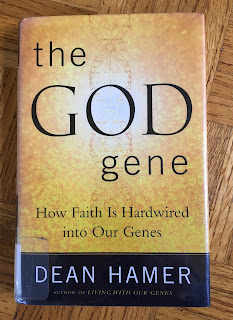
First, it is important to differentiate between spirituality and religion. According to Dean Hamer, author of “The God Gene: How Faith is Hardwired into Our Genes”, there is “a sharp distinction between spirituality, which is a personality trait that some of us have to a greater or lesser extent than others, and religion, which is a culturally transmitted expression of spirituality.”

In his book, Hamer contends that one's predisposition toward spirituality is influenced by genetic factors. More controversially, he proposes that the VMAT2 gene is one of many potential genes that influence spirituality. Hamer identifies one particular variation, a change from an A to a C, present in 28% of the alleles in his data set, as a marker for the more “spiritual” version of this gene.

Among the skeptics of Hamer’s work was John Polkinghorne (1930-2021) an English theoretical physicist, theologian, and Anglican priest. Commenting on “The God Gene” for The Daily Telegraph, he said "The idea of a God gene goes against all my personal theological convictions. You can't cut faith down to the lowest common denominator of genetic survival. It shows the poverty of reductionist thinking."

Exploring genetic predisposition isn’t an attempt to reduce whether or not you have faith in God to your genetics. It is exploring the possibility that genes may impact how deeply you embrace whichever faith or spiritual philosophy you identify with. 
spectrumagazine.org
Other research suggests that one of the main reasons why individuals differ in strength of spirituality (but not religious affiliation) is because of their genetics. It seems that there is some kind of predisposition to being relatively more or less spiritual, with estimates suggesting that 30-50% of differences in spirituality is due to genes. 
 
“Until about 25 years ago, scientists assumed that religious behavior was simply the product of a person’s socialization – or ‘nurture’. But more recent studies, including those on adult twins who were raised apart, suggest genes contribute about 40% of the variability in a person’s religiousness.” - Maggie Mckee
csail.mit.edu

It might be that some variation in personal spirituality is explained by genetics, although spirituality is a complex trait influenced by many genes as well as upbringing and culture. Genetics probably play a small part, but we could surely benefit from at least some understanding of that small part.

All of this seems to suggest that there might be:

  • good reason to view spirituality as another part of the rich genetic and cultural variety that makes us human,
  • and an even better reason to learn to respect and enjoy the full range of that variety.