Saturday, March 6, 2021

One Year Later ... Pandemic Guilt

2020 Gate River 15K, my last race before the pandemic lock down.

Prior to the pandemic, my morning runs were “dictated” by which race was I was training for. I have training plans for 5Ks through full marathon distances. But during the lock down there were no races to train for. Which, initially, made me think I needed virtual races to fill my “training” void – I needed a “plan.” Well, that worked for two virtual races but I lost interest in following a “plan.”
Then I decided to create my own virtual runs and connect them with my other passion, reading. Instead of following a training plan, I would trace my mileage on literary maps. But by August, 2020, I lost interest in logging my distance on maps. 
As with other aspects of my life during the pandemic, I asked myself a core question “What is essential?”

While it did take me a few months to break the training plan/race habit, I finally discovered what was essential for me - the simple joy of motivating myself. Training plans are not essential to be a runner! I begin each day with a run for no other reason than I am happy to be alive and proud that I can do it on my own. I certainly don’t need any more training plans, medals or t-shirts nor do speed or distance matter. For me, the simple act of running … just moving outdoors - is essential, life-affirming! During the pandemic, I’m actually okay, more than okay -- dare I say, I am thriving?!
 
How can I be thriving while others were suffering incalculable loses?  As the pandemic continues, more and more people are losing loved ones, becoming ill, suffering long term effects of illness, losing their jobs and income, supporting family members who have lost their jobs, and many, particularly women, are trying to balance their children’s schoolwork with their job... it’s difficult to find someone whose life has not been impacted in some way by the pandemic. 
 

My pandemic guilt is the feeling that I am not suffering at all and I don’t deserve to feel like I am thriving as others are experiencing great loss and stress. I feel guilty about feeling “okay.”

According to Professor Kim Felmingham from the University of Melbourne, “Feeling guilty about being “OK” during these challenging times isn’t just a “perfectly normal” reaction — it’s part of our evolutionary programming. That’s because feeling pandemic guilt means you are feeling empathy for others who have been less fortunate. In an evolutionary sense, empathy allows us to form close social bonds and connections with others. So give yourself a break, don’t beat yourself up if you are feeling guilty.” 1

Yet, I struggle with pandemic guilt. It is a feeling like cancer survivors’ guilt, “Why did that wonderful person suffer more or why did that younger person die and I didn’t?” I don’t know the answer nor do I know why I am not suffering like so many others are during this pandemic.  All I know is that I have no control over the pandemic, I can only help prevent the spread.  Ultimately I just happen to be fortunate enough to be healthy and able to withstand the pandemic hardships.

There are 3 things that have helped me deal with my feelings of pandemic guilt – running, “Daily Joy Increases,” and volunteering.
 

Fortunately, an expert agrees with me! According to Julia Chislenko, a therapist:

1. “First, we need to take care of our basic needs: food, sleep, exercise.”

2. “Everybody deserves to feel safe, happy, and healthy and if you have one or more of those things, try to manage your feelings of guilt by replacing them with gratitude. Say to yourself, ‘I deserve to be healthy, I am grateful for my privilege, and I am thankful that I have the energy to use my health and privilege for good.’”

3. “Then do what you can with what you have. If you have the financial means to do so, donate. If you can volunteer time, that is also incredibly helpful… even checking in virtually with a family member or friend are all ways to replace feelings of shame with positive actions.”2

Everyone’s pandemic experience is unfolding differently. All our unique experiences and feelings within this pandemic are valid. We just need to remember "It's okay NOT to be okay” AND “It's okay to be okay, too.” 3


1. https://theconversation.com/its-ok-to-be-ok-how-to-stop-feeling-survivor-guilt-during-covid-19-143457

2. https://mywellbeing.com/therapy-101/what-is-pandemic-guilt-and-how-to-cope

3. https://www.psychologytoday.com/au/blog/flourish/202005/its-ok-not-be-ok


Saturday, February 27, 2021

Hey, Fat A$$!

“Hey, fat a$$! You look like a hippo in heat!”
Now there’s something you don’t hear everyday. I heard this while running a half marathon in Greer, South Carolina. The man yelling was sitting in a lawn chair ... drinking a beer … at 8am ... yelling at a pack of runners.

In the pack, everyone’s jaw fell open as we glanced at each other and then back at the man. He’s not yelling something positive like, “You rock!” or “You got this!” or even holding two thumbs up. No, he’s yelling, “Hey, fat a$$! You look like a hippo in heat!”

I wish I could say the man in the lawn chair was an aberration, but, sadly, he is not.

During the 2019 London Marathon, contractors hired by the race organizers started to clear up the water stops and the finish line before the time limit, while runners were still running. The contractors shouted at and heckled the runners: "If you weren't so fat, you could run", and "This is a race, not a walk". 1

During the 2017 New York City Marathon, a runner was personally targeted by a heckler between the 22nd. and 23rd. mile. A man leered at her and said, “It’s gonna take your fat a$$ forever, huh? “ 2

A fellow runner in the Slow Runners Community on Facebook posted this about a heckling that took place in her apartment complex gym: “I use the treadmill 6 days a week and had never seen this guy before. I know he was talking to me because he actually got my attention. People have done this before usually to ask if I’m ok with them turning the TV on. When I pulled out my headphones he looked me up and down said, 'Mooooooo.' Laughed and left.”

Then there are these comments from a Runbundle thread about being heckled while running:
  • “I've been barked at twice by people in cars.”
  • “I was in Vegas this weekend and did a run on the strip. I heard someone yell 'Woo pig soooeee' behind me.”
  • “I was a new runner shuffling along when someone yelled out of a car in a mocking tone "Are you RUNNING!?" I quit running for like a year or so because of that. I still get heckled with laughter and hoots for my awkward gait.”3
The man in the lawn chair was probably drunk, but what about all the sober hecklers? Certainly over the past five years we've gotten too used to heckling and name calling. Does it have to be like this? No.

The 2019 London Marathon organizers apologized to the runners who were heckled by their contract employees and said they will make changes to prevent this from happening again. They will start the clean-up operation later, inform contractors of the procedures for dealing with slow runners, and look at how water should be handed out. They also gave the runners who were heckled free entry for the 2020 marathon. (Due to the pandemic, the 2020 race only allowed elite participants. I hope the free entry is good for … whenever.)

The runner who was heckled during the 2017 New York Marathon, LaToya Shauntay Snell, went home home and wrote about her heckling experience on social media platforms. She went viral as other people responded with similar experiences. Now she is a freelance chef, photographer, contributing writer for The Root and founder of RunningFatChef, a food-and-fitness blog that documents her experiences as a plus-size marathoner, ultra-marathoner and obstacle-course racer. She has been featured on multiple platforms such as People Magazine, BuzzFeed Health, Self Magazine, Refinery29 and Women’s Running. She said, “My mission was to let people know they weren’t alone—that they, too, can push past disparaging, unsolicited comments.”

The treadmill runner who was heckled in her apartment complex gym posted her experience in our Slow Runners Community on Facebook. Her post generated 833 comments of support! She plans to ignore the “jerk” and keep on running.

Which brings me back to the lawn chair man -“Hey, fat a$$! You look like a hippo in heat!” - well, we all just started laughing!  His heckling became, literally, a running joke. For the next 10 miles the pack banter was almost non-stop:
  • at the water stops - “Coming through, hippo in heat!”, “My fat a$$ needs some water”,
  • at the energy gel table -“I am one hungry, hungry hippo!”, “I hope this gel doesn’t go straight to my fat a$$!”
  • and at the finish – “Thanks to my fat a$$, I made it!”, “Nothing can stop a hippo in heat!”, etc. 
tenor.com
Obviously, these heckling situations do not lend themselves to a “conversation” with the person who just called you a name or compared you, negatively, to an animal. Plus, you can’t change anyone except yourself.

Most of the people who heckle runners are too out of shape to run a single mile. Once I responded to a heckler by inviting him to run with me ... “I only have 5 more miles.” He declined.

Adam Krajchir, founder and director of Race with Purpose has a better suggestion: “Instead of taking the bait and heckling back, use the other's rudeness for your gain. Take negative things and spin it. See it as a compliment, that it means, 'I'm doing something that they can't do. I'm doing exactly what I should be doing.'" 4

Finally, most people are really nice and would never think to heckle a runner. But there are a very few people who are unable to keep negative comments to themselves and you know what? You don't need to listen to them. Keep moving, you are doing exactly what you should be doing.
 

Sunday, January 31, 2021

"You'll Blow Your Knees Out, Kid!"


“Excuse me!” a man called to me. He was standing in the McDonald’s parking lot waving his arms. “Can I ask you a couple questions? I am a reporter for the Washington Post.”
It was five years ago, in Leesburg, Virginia, a snowstorm was blowing through and I was trying to get my morning run in before the snow got too deep.
“Sure,” I said as I paused my watch.
“You must be training for a race to be running in this mess. What race are you training for?”
“None, I’m just running.”
The man looked crestfallen, his shoulders sagged. I told him, “I’m a recreational runner.”
He started to walk away, “Oh, okay, thanks.”
“Enjoy the snow!” I called after him. I restarted my watch and continued my slow, steady run.

While the reporter didn’t think recreational running was newsworthy, I do! 
Here is some timely, important, and interesting information for recreational runners, walkers … AND THEIR KNEES!
The idea that running wrecks knees has been around for decades.  Well-meaning, non-running family members, friends and strangers persist in telling me that my knees are doomed - that my running will “blow out my knees.”  Or, at the very least, cause arthritis.
 
 
GOOD NEWS! In a review of 17 studies, which included 114,829 people, researchers found that:
  • only 3.5% of recreational runners had hip or knee arthritis; this was true for both male and female runners.
  • 10.2% of sedentary people had a higher rate of hip or knee arthritis.
  • 13.3% of runners who were at the elite, ex-elite, or professional level – more than 57 miles per week - had the highest rate of knee or hip arthritis. 1
The researchers concluded that running at a recreational level for many years—up to 15 years and possibly more—may be safely recommended as a general health exercise, and benefits hip and knee joint health. Good news – especially since I am way, way, way past the 15 year mark! 😬
 

High mileage is not required to reduce your risk of arthritis and hip replacement. Another study found that recreational runners who ran at least 1.2 miles per day had a 15 percent lower risk of osteoarthritis and a 35 percent lower risk of hip replacement than those who were less active. 2

Finally, another study found that recreational running and walking may actually help the cartilage (
the rubbery tissue that cushions the ends of bones) in your knees. For decades it was thought that years of running would wear away cartilage and lead to knee arthritis.  However, Ross Miller, an associate professor of kinesiology at the University of Maryland in College Park, found that cartilage is malleable, it can rebuild itself, and become stronger. Recreational walking and running bolsters knee cartilage health. 3
roadrunnersports.com
 
But what about “runner’s knee?”

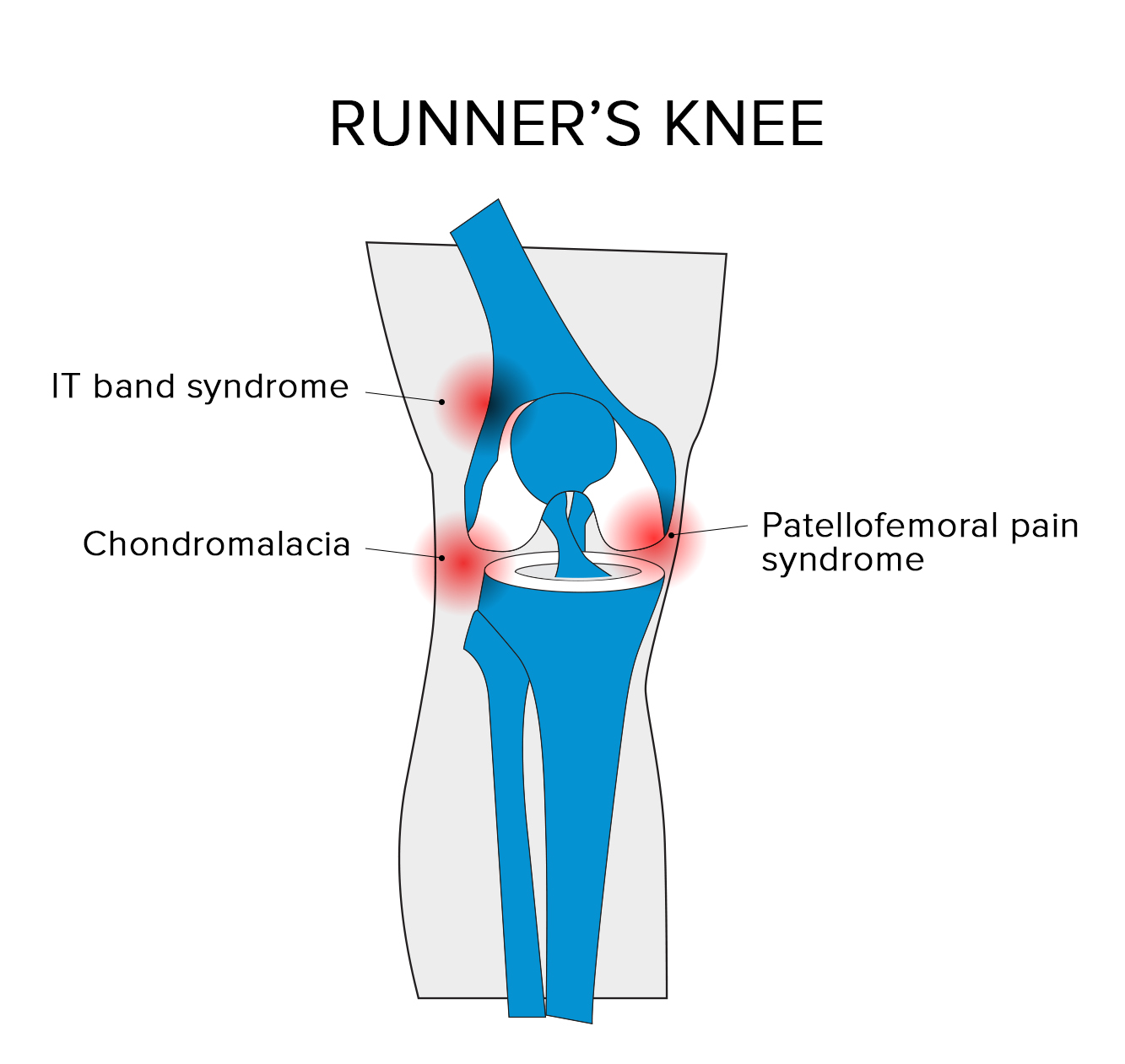
Yes, it is true that some runners experience sore or painful knees. The most common knee injury, “runner's knee,” is actually chondromalacia patella or patellafemoral pain syndrome. This is an inflammation of the cartilage under your kneecap. Sports medicine professionals agree that people with “runner’s knee” actually have a few common biomechanical problems. These include:
  • weak hips and glutes, which introduce instability further down the legs;
  • weak quadriceps, which can make it difficult for the kneecap to track properly;
  • and tight hamstrings, which shift some of running's impact to the knees. 
In addition, extra body weight places tremendous strain on your knees. (The American College of Sports Medicine has said that each additional pound of body mass puts four extra pounds of stress on the knee.) Watch your weight but keep moving, that will help you maintain a healthy body weight. 
 
Finally, running or walking on uneven, slanting ground increases the torque on your knees. Flat, level surfaces are best for walking and running. 4
 
(A good strengthening program, like this one, can help prevent “runner's knee.”  If you experience knee pain or swelling, follow your medical professional's recommendations. ) 
 

WAIT … There’s Even more GOOD NEWS!

Recreational running isn't only good for your knees, it's also good for your mind. A good run or walk, especially during this pandemic, can do wonders for your mental health. Research shows that just 30 minutes of walking per day can reduce symptoms of depression. 5
 

bee's knees n. Something excellent, outstanding ... newsworthy!
 
Recreational runners and walkers do not compete to see who can be the fastest or who can cover the longest distance, but they are newsworthy.  Snow, rain, wind, heat … you will see them everyday, running, walking, … engaging in a timely, interesting, and important activity - healthy living. And that, I think, is the best news of all!  😀

Sunday, January 17, 2021

Is Cheating a Joke?

IS CHEATING A JOKE?

At the first American Olympic Games in 1904 in St. Louis, Fred Lorz finished first in the marathon. Later, Lorz acknowledged that he was “helped by hitchhiking after suffering from cramps.” When asked about his actions, Lorz replied, “It was all a joke.”1

I'M NOT LAUGHING!

More recent runners have also been caught cheating. The most common methods of cheating are course-cutting and bib-swapping. On some courses, it’s possible to cut off distance on foot, but on others, course-cutting requires the aid of a car, bike, or public transportation. Bib-swapping can also take on a variety of forms. Race directors and timers have seen runners get faster athletes to run in their place, runners wearing multiple bibs or chips for the same purpose, and runners splitting up a race (handing off a bib and/or chip midway through). However creative the method, it is still cheating!
 
“Pulling a Rosie”
Probably the most famous cheater was Rosie Ruiz (1953-2019). Her name become synonymous with cheating when the 1980 Boston Marathon officials vacated her victory after determining she had sneaked onto the course about a mile from the finish line. On video tapes of the marathon, Ruiz was nowhere to be found and her number, W50, was not on any of the course marshals’ checkpoint lists. After “pulling a Rosie,” Ruiz was then arrested for embezzling $60,000 from a real estate company where she worked and again in 1983 for her involvement in a cocaine deal.2

“Follow the leader”??!!
One of the most dramatic cases of cheating happened at the 2005 Marine Corps Marathon, when 325 (!!!!) members of the group Jean’s Marines were disqualified after they cut four miles off the course. They wanted finishers’ medals, and on the advice (!!!) of the group’s leader, they took a shortcut to ensure that they got to the finish line before the course closed.3

“Pants on fire!”
Some runners are honest enough to admit they cheated (although dishonest enough in the first place to cheat). Then there are runners who lie. Inflating time or distance with family and friends only hurts the runner. But when a runner lies while representing a company or charity, he ruins, not just his own reputation, but drags their reputations down with him. 
 
Michael Shifflett, was an ambassador for the 6 AM Run company, a supplier of nutritional supplements and running gear. Shifflett said he ran the January 2020 Disney marathon and claimed to finish in 4th place. 6 AM Run then posted his photo on their company Instagram account in celebration of his success. But Shifflett was not in the official results, he did not finish. He last crossed a tracking mat at the 10 mile mark. Once 6 AM Run became aware of his lie, they severed ties with Shifflett and said they planned to institute a vetting process for all their company ambassadors.
 
When asked about his actions, Shifflett replied, “I didn’t cheat, I lied”.4  


A Cheating Tragedy
 
Dr. Fed Meza was a retired South Pasadena, California physician, a longtime runner, and track coach. He was a “good guy,” well respected in his community. However, he was disqualified in both the 2014 and 2015 California International Marathons for irregular splits, the times recorded at various points along the course. In 2015, he was banned from ever competing in the California International Marathon again.

At the 2014 San Francisco Marathon, Meza was accused of “cutting the course.” He was photographed riding a bike.5

When Meza recorded irregular splits at the 2015 L.A. Marathon, officials lacked evidence to take action but requested he run with an observer the following year. He did not run LA the following year nor the next three years.

Instead he ran the 2019 L.A. Marathon without an observer. Again, he had irregular splits. “After an extensive review of original video evidence from official race cameras and security cameras at retail locations along the race course, Conqur Endurance Group (sponsor of the marathon) has determined that Dr. Frank Meza violated a number of race rules during the 2019 Skechers Performance Los Angeles Marathon, including re-entering the course from a position other than where he left it.”

On July 4, 2019 Meza was found dead in the Los Angeles River under a bridge about a mile from Dodger Stadium, days after race officials threw out his result over allegations that he’d cheated – accusations that he’d denied. His family said he had been diagnosed recently with atrial fibrillation. Also, they said he was also under enormous stress over his disqualification and the cheating claims made in blog posts and media reports. Meza’s daughter, Lorena Meza, said, “He was targeted, bullied and we tried to defend him the best we could. He was so devastated that people could actually believe this.”6
 
*PERSONAL NOTE:* Meza did not leave a note explaining his suicide but obviously he must have been suffering. Since 2014 he had dealt with legitimate accusations of cheating from race directors. In 2019, the general public became aware of the accusations. Should a cheater be disqualified and face consequences, like banning, for habitual cheating? Absolutely. There should be accountability for our actions. But online, personal shaming goes too far, - there is a difference between critical and hateful comments. If you suspect cheating, contact the race officials directly with your concerns. 
 

What’s Wrong with Cheating?
  • A runner who cheats by bib-swapping for a qualifying time to enter a limited field race may take the place of an honest runner.
  • Course-cutting and bib-swapping affect the overall standings and age-group awards.
  • Cheaters can also rob the true winners of their moments of glory.
  • Cheating devalues the efforts of those who run the course honestly.

It boils down to integrity. Running with integrity means being consistently honest and showing an uncompromising adherence to the race rules. 


Motivation plays a key role in whether a runner acts with integrity or not. 
 
Intrinsic motivation is where the runner wants to reach a high, personal standard for their own satisfaction. These runners are really competing against themselves.
 
Extrinsic motivation is where the runner is externally motivated and they’re more concerned with the result of their effort, whatever that might be—recognition from friends, a medal, to say that they qualified for an “elite” race or had an extremely fast pace. They’re more concerned with how this impacts other people and what other people think of them. 
 
Jack J. Lesyk, Ph.D., CC-AASP, director of the Ohio Center for Sports Psychology, says that people who are externally motivated—driven by recognition from others—can derive satisfaction from getting a race medal, even if they didn’t earn it. Cheating seems an acceptable way to get what they want. 
 
He goes on to say that if a runner is intrinsically motivated, they would not feel greatly rewarded unless they really earned it. Cheating is not acceptable if a runner’s motivation is to run honestly and to the best of her ability. The “reward” is in being satisfied with her efforts.7
 
Whether or not runners cheat depends on their integrity and motivation. Only they can decide if cheating will become a habitual behavior or an unfortunate mistake never to be repeated.