Sunday, March 21, 2021

Are You "Crushing It"?


“Research on aging runners shows that you can not only stay in the game but also—contrary to popular belief—keep crushing it far longer than you may think.” 1

Sounds wonderful! But, suddenly, one day you realize you can’t keep “crushing it” like you did in the past. Besides your aging body, you may be experiencing chronic pain, cancer, and other physical or psychological challenges. What to do?

Don’t give up!

All that running has kept you in pretty good shape compared to people who did not engage in vigorous physical activities. A new study published in the journal JAMANetwork Open contains an alarming statistic: “A quarter of all women over the age of 65 are physically incapable of walking just two or three blocks or climbing a single flight of stairs. The researchers cite the ‘lack of moderate to vigorous-intensity physical activity’ as the single biggest culprit for this, which over time manifests itself in mobility disability.”

“Crushing It”?

At first, I felt relieved to read this study since I have been running for decades. But while running is a great way to engage in a vigorous physical activity, “crushing it” like I did in the past is not realistic.

For too long my goal had been to run continuously – no breaks, as fast, and as far as I could. I thought rattling off a litany of past and current injuries to fellow runners was evidence of my dedication to the sport. About five years ago, I finally realized those injuries were actually evidence of my dedication to “crushing it” rather than a healthy body. In fact, about 50 to 75% of all running injuries are overuse injuries, in other words, a runner’s dedication to physically overdoing it. 2

Continually “crushing it” psychologically can also be unhealthy. For many years I berated myself when I slackened my pace, ran a shorter distance, or took a walk break. I thought lessening my intensity was “failure.” In fact, many former runners told me they quit running because it was "too depressing" because:  - they were no longer “crushing it” - they were not going to get any faster nor run another marathon, so “Why bother?”  Thankfully, I don’t share their feelings but I “get” why they feel that way. Despair and depression are not healthy, and I want to be healthy. 

I am not fast, nor do I have the endurance I had in previous years. I know my days as a runner are numbered. …. yet I still want to run.

Fortunately, theJAMA study also concluded that even low-intensity physical activity is beneficial. The study findings suggest that “ALL movement, not just moderate-vigorous physical activity, is important and that greater emphasis should be placed on promoting low-intensity physical activity for preserving mobility in later life.” Incorporating less intense physical activities, especially for an aging runner, can be effective and beneficial. Here are my three, recommended low-intensity activities. 

1. LISS Activities

LISS is “low-intensity, steady state” exercise. During LISS you might break a light sweat, but not much more. Your breathing is fairly steady, and you can easily carry on a conversation (aka the “talk test”). Simply put, LISS involves elevating your heart rate with activity, but not letting it go beyond 50 percent of your maximum heart rate, and then keeping it there for at least 30 minutes. I prefer to use the “talk test” but you can estimate your maximum heart rate by subtracting your age from 220.

You can also use heartbeats per minute to measure intensity. Sports and conditioning coach Mike Robertson recommends keeping your BPM (beats per minute) between 120 and 150 for low-intensity exercise. 3

Examples of LISS activities: 
  • slow jog, 
  • walk/hike on flat terrain, 
  • riding a bicycle at an easy pace of less than five miles per hour and at a low resistance,
  •  leisurely swimming

You won’t increase your risk of injury to the same extent as if you just ran “junk miles.”

In fact, brisk LISS-walking (at least 30 minutes, light sweat) can actually help raise your calorie burn to the same amount as what you’d burn jogging. LISS-walking builds and maintains lower extremity and core strength, helps clear your mind, and, for runners, it’s a great way to have an active recovery day. 4 

* I run six mornings a week and LISS-walk one. My challenge is to simply enjoy LISS and not worry about “crushing it” with a fast pace or long distance.  Eventually I will transition from frequent running to more frequent LISS acitivities.

2. Simple Walk Breaks

According to Trainer, Ania Gabb, regular walking breaks while running actually makes you a better runner. “People who run a lot can push their bodies too hard and end up injuring themselves, so implementing walking breaks is a good way to prevent injury mid-run. After a one or two-minute break of just walking, you’ll be able to carry on stronger.” 5

Jeff Galloway, running coach and creator of the popular Run Walk Run Method, started training runners by having them focus on their breathing, “The huff-and-puff rule emerged: when you hear huffing and puffing increase, take more frequent walk breaks and slow the pace.” 6

*I am taking guilt-free walk breaks or slowing my pace when I find I am “huffing & puffing.” Eventually I will probably transition to Run Walk Run or what physiotherapist, Sammy Margo suggests: “Warm up by walking briskly for three or four minutes, keeping an upright posture with your core held in and arms swinging. Now break into a jog or run for five minutes before returning to walking for one minute. Continue with a five-minute run, one-minute walk until you’ve exercised for 30 minutes. Walk for three or four minutes to cool down.” 7
 

3. Walking, Walking!

Walking provides a lot of the same benefits as running, and is a valuable workout in its own right. 8 Walking regularly reduces your risk of hypertension, high cholesterol, diabetes and improve your cardiovascular health.9 Plus, a good walk does wonders for your mental health and can reduce symptoms of depression. 10

*My daily routine includes a mid-morning dog walk at a park and an afternoon stroll around our neighborhood. In the future, I will probably transition from 1 run and 2 walks a day to 3 walks a day – and from there, I guess it will be 3 – 2 – 1 - done! 

You Are Crushing It!

My running guru, Dr. George Sheehan, once said, “Growing old is a game of verve and imagination and excitement.” He ran with metastatic prostate cancer for seven years before his death in 1993. Several months before his death he could no longer run but he was still ambulatory. He was “crushing it.”

It is difficult to break the notion that you should always be “crushing it” like you did before you began aging, or experienced chronic pain, cancer, and other physical or psychological challenges. Life eventually necessitates a transition from vigorous physical activities to moderate and low-intensity activities. LISS, walk breaks, and daily walks are three ways to keep you injury free, preserve your mobility, and incorporate “verve and imagination and excitement” into your healthy lifestyle. 

1. https://www.runnersworld.com/training/a28691136/aging-runners/

2. https://link.springer.com/article/10.2165%2F00007256-199214050-00004

3. https://robertsontrainingsystems.com/blog/long-duration-low-intensity-cardio/

4. https://www.livestrong.com/article/1012273-steadystate-cardio-new-feelgood-workout/

5. https://www.stylist.co.uk/fitness-health/workouts/running-can-walking-breaks-while-running-make-you-a-better-runner/493856

6. http://www.jeffgalloway.com/training/run-walk/

7. https://www.stylist.co.uk/fitness-health/workouts/running-can-walking-breaks-while-running-make-you-a-better-runner/493856

8. https://www.runnersworld.com/training/a32712350/walking-more/

9. https://www.ncbi.nlm.nih.gov/pmc/articles/PMC4067492/

10. https://www.thelancet.com/journals/lanpsy/article/PIIS2215-0366(18)30227-X/fulltext


Saturday, March 6, 2021

One Year Later ... Pandemic Guilt

2020 Gate River 15K, my last race before the pandemic lock down.

Prior to the pandemic, my morning runs were “dictated” by which race was I was training for. I have training plans for 5Ks through full marathon distances. But during the lock down there were no races to train for. Which, initially, made me think I needed virtual races to fill my “training” void – I needed a “plan.” Well, that worked for two virtual races but I lost interest in following a “plan.”
Then I decided to create my own virtual runs and connect them with my other passion, reading. Instead of following a training plan, I would trace my mileage on literary maps. But by August, 2020, I lost interest in logging my distance on maps. 
As with other aspects of my life during the pandemic, I asked myself a core question “What is essential?”

While it did take me a few months to break the training plan/race habit, I finally discovered what was essential for me - the simple joy of motivating myself. Training plans are not essential to be a runner! I begin each day with a run for no other reason than I am happy to be alive and proud that I can do it on my own. I certainly don’t need any more training plans, medals or t-shirts nor do speed or distance matter. For me, the simple act of running … just moving outdoors - is essential, life-affirming! During the pandemic, I’m actually okay, more than okay -- dare I say, I am thriving?!
 
How can I be thriving while others were suffering incalculable loses?  As the pandemic continues, more and more people are losing loved ones, becoming ill, suffering long term effects of illness, losing their jobs and income, supporting family members who have lost their jobs, and many, particularly women, are trying to balance their children’s schoolwork with their job... it’s difficult to find someone whose life has not been impacted in some way by the pandemic. 
 

My pandemic guilt is the feeling that I am not suffering at all and I don’t deserve to feel like I am thriving as others are experiencing great loss and stress. I feel guilty about feeling “okay.”

According to Professor Kim Felmingham from the University of Melbourne, “Feeling guilty about being “OK” during these challenging times isn’t just a “perfectly normal” reaction — it’s part of our evolutionary programming. That’s because feeling pandemic guilt means you are feeling empathy for others who have been less fortunate. In an evolutionary sense, empathy allows us to form close social bonds and connections with others. So give yourself a break, don’t beat yourself up if you are feeling guilty.” 1

Yet, I struggle with pandemic guilt. It is a feeling like cancer survivors’ guilt, “Why did that wonderful person suffer more or why did that younger person die and I didn’t?” I don’t know the answer nor do I know why I am not suffering like so many others are during this pandemic.  All I know is that I have no control over the pandemic, I can only help prevent the spread.  Ultimately I just happen to be fortunate enough to be healthy and able to withstand the pandemic hardships.

There are 3 things that have helped me deal with my feelings of pandemic guilt – running, “Daily Joy Increases,” and volunteering.
 

Fortunately, an expert agrees with me! According to Julia Chislenko, a therapist:

1. “First, we need to take care of our basic needs: food, sleep, exercise.”

2. “Everybody deserves to feel safe, happy, and healthy and if you have one or more of those things, try to manage your feelings of guilt by replacing them with gratitude. Say to yourself, ‘I deserve to be healthy, I am grateful for my privilege, and I am thankful that I have the energy to use my health and privilege for good.’”

3. “Then do what you can with what you have. If you have the financial means to do so, donate. If you can volunteer time, that is also incredibly helpful… even checking in virtually with a family member or friend are all ways to replace feelings of shame with positive actions.”2

Everyone’s pandemic experience is unfolding differently. All our unique experiences and feelings within this pandemic are valid. We just need to remember "It's okay NOT to be okay” AND “It's okay to be okay, too.” 3


1. https://theconversation.com/its-ok-to-be-ok-how-to-stop-feeling-survivor-guilt-during-covid-19-143457

2. https://mywellbeing.com/therapy-101/what-is-pandemic-guilt-and-how-to-cope

3. https://www.psychologytoday.com/au/blog/flourish/202005/its-ok-not-be-ok


Saturday, February 27, 2021

Hey, Fat A$$!

“Hey, fat a$$! You look like a hippo in heat!”
Now there’s something you don’t hear everyday. I heard this while running a half marathon in Greer, South Carolina. The man yelling was sitting in a lawn chair ... drinking a beer … at 8am ... yelling at a pack of runners.

In the pack, everyone’s jaw fell open as we glanced at each other and then back at the man. He’s not yelling something positive like, “You rock!” or “You got this!” or even holding two thumbs up. No, he’s yelling, “Hey, fat a$$! You look like a hippo in heat!”

I wish I could say the man in the lawn chair was an aberration, but, sadly, he is not.

During the 2019 London Marathon, contractors hired by the race organizers started to clear up the water stops and the finish line before the time limit, while runners were still running. The contractors shouted at and heckled the runners: "If you weren't so fat, you could run", and "This is a race, not a walk". 1

During the 2017 New York City Marathon, a runner was personally targeted by a heckler between the 22nd. and 23rd. mile. A man leered at her and said, “It’s gonna take your fat a$$ forever, huh? “ 2

A fellow runner in the Slow Runners Community on Facebook posted this about a heckling that took place in her apartment complex gym: “I use the treadmill 6 days a week and had never seen this guy before. I know he was talking to me because he actually got my attention. People have done this before usually to ask if I’m ok with them turning the TV on. When I pulled out my headphones he looked me up and down said, 'Mooooooo.' Laughed and left.”

Then there are these comments from a Runbundle thread about being heckled while running:
  • “I've been barked at twice by people in cars.”
  • “I was in Vegas this weekend and did a run on the strip. I heard someone yell 'Woo pig soooeee' behind me.”
  • “I was a new runner shuffling along when someone yelled out of a car in a mocking tone "Are you RUNNING!?" I quit running for like a year or so because of that. I still get heckled with laughter and hoots for my awkward gait.”3
The man in the lawn chair was probably drunk, but what about all the sober hecklers? Certainly over the past five years we've gotten too used to heckling and name calling. Does it have to be like this? No.

The 2019 London Marathon organizers apologized to the runners who were heckled by their contract employees and said they will make changes to prevent this from happening again. They will start the clean-up operation later, inform contractors of the procedures for dealing with slow runners, and look at how water should be handed out. They also gave the runners who were heckled free entry for the 2020 marathon. (Due to the pandemic, the 2020 race only allowed elite participants. I hope the free entry is good for … whenever.)

The runner who was heckled during the 2017 New York Marathon, LaToya Shauntay Snell, went home home and wrote about her heckling experience on social media platforms. She went viral as other people responded with similar experiences. Now she is a freelance chef, photographer, contributing writer for The Root and founder of RunningFatChef, a food-and-fitness blog that documents her experiences as a plus-size marathoner, ultra-marathoner and obstacle-course racer. She has been featured on multiple platforms such as People Magazine, BuzzFeed Health, Self Magazine, Refinery29 and Women’s Running. She said, “My mission was to let people know they weren’t alone—that they, too, can push past disparaging, unsolicited comments.”

The treadmill runner who was heckled in her apartment complex gym posted her experience in our Slow Runners Community on Facebook. Her post generated 833 comments of support! She plans to ignore the “jerk” and keep on running.

Which brings me back to the lawn chair man -“Hey, fat a$$! You look like a hippo in heat!” - well, we all just started laughing!  His heckling became, literally, a running joke. For the next 10 miles the pack banter was almost non-stop:
  • at the water stops - “Coming through, hippo in heat!”, “My fat a$$ needs some water”,
  • at the energy gel table -“I am one hungry, hungry hippo!”, “I hope this gel doesn’t go straight to my fat a$$!”
  • and at the finish – “Thanks to my fat a$$, I made it!”, “Nothing can stop a hippo in heat!”, etc. 
tenor.com
Obviously, these heckling situations do not lend themselves to a “conversation” with the person who just called you a name or compared you, negatively, to an animal. Plus, you can’t change anyone except yourself.

Most of the people who heckle runners are too out of shape to run a single mile. Once I responded to a heckler by inviting him to run with me ... “I only have 5 more miles.” He declined.

Adam Krajchir, founder and director of Race with Purpose has a better suggestion: “Instead of taking the bait and heckling back, use the other's rudeness for your gain. Take negative things and spin it. See it as a compliment, that it means, 'I'm doing something that they can't do. I'm doing exactly what I should be doing.'" 4

Finally, most people are really nice and would never think to heckle a runner. But there are a very few people who are unable to keep negative comments to themselves and you know what? You don't need to listen to them. Keep moving, you are doing exactly what you should be doing.
 

Sunday, January 31, 2021

"You'll Blow Your Knees Out, Kid!"


“Excuse me!” a man called to me. He was standing in the McDonald’s parking lot waving his arms. “Can I ask you a couple questions? I am a reporter for the Washington Post.”
It was five years ago, in Leesburg, Virginia, a snowstorm was blowing through and I was trying to get my morning run in before the snow got too deep.
“Sure,” I said as I paused my watch.
“You must be training for a race to be running in this mess. What race are you training for?”
“None, I’m just running.”
The man looked crestfallen, his shoulders sagged. I told him, “I’m a recreational runner.”
He started to walk away, “Oh, okay, thanks.”
“Enjoy the snow!” I called after him. I restarted my watch and continued my slow, steady run.

While the reporter didn’t think recreational running was newsworthy, I do! 
Here is some timely, important, and interesting information for recreational runners, walkers … AND THEIR KNEES!
The idea that running wrecks knees has been around for decades.  Well-meaning, non-running family members, friends and strangers persist in telling me that my knees are doomed - that my running will “blow out my knees.”  Or, at the very least, cause arthritis.
 
 
GOOD NEWS! In a review of 17 studies, which included 114,829 people, researchers found that:
  • only 3.5% of recreational runners had hip or knee arthritis; this was true for both male and female runners.
  • 10.2% of sedentary people had a higher rate of hip or knee arthritis.
  • 13.3% of runners who were at the elite, ex-elite, or professional level – more than 57 miles per week - had the highest rate of knee or hip arthritis. 1
The researchers concluded that running at a recreational level for many years—up to 15 years and possibly more—may be safely recommended as a general health exercise, and benefits hip and knee joint health. Good news – especially since I am way, way, way past the 15 year mark! 😬
 

High mileage is not required to reduce your risk of arthritis and hip replacement. Another study found that recreational runners who ran at least 1.2 miles per day had a 15 percent lower risk of osteoarthritis and a 35 percent lower risk of hip replacement than those who were less active. 2

Finally, another study found that recreational running and walking may actually help the cartilage (
the rubbery tissue that cushions the ends of bones) in your knees. For decades it was thought that years of running would wear away cartilage and lead to knee arthritis.  However, Ross Miller, an associate professor of kinesiology at the University of Maryland in College Park, found that cartilage is malleable, it can rebuild itself, and become stronger. Recreational walking and running bolsters knee cartilage health. 3
roadrunnersports.com
 
But what about “runner’s knee?”

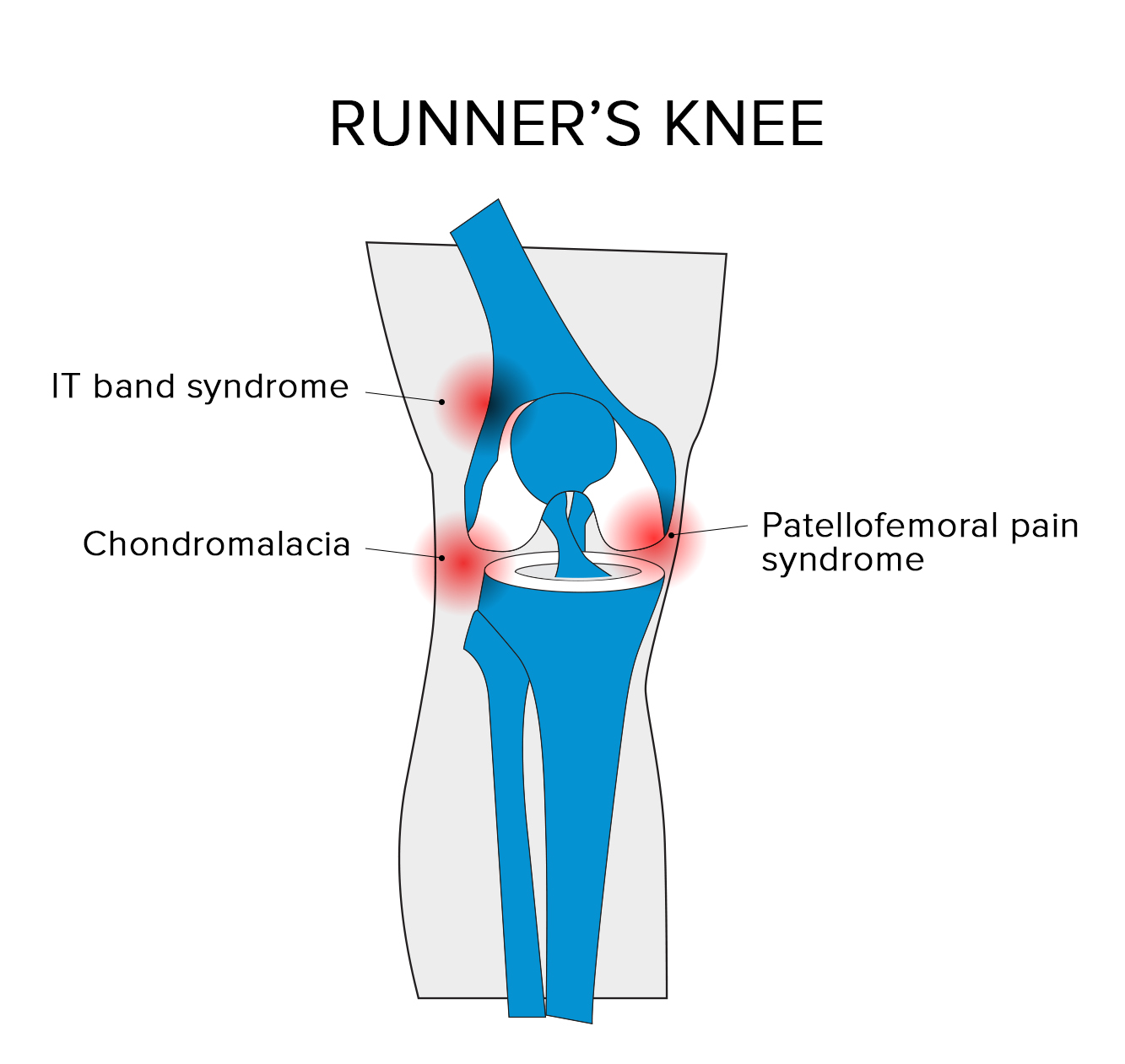
Yes, it is true that some runners experience sore or painful knees. The most common knee injury, “runner's knee,” is actually chondromalacia patella or patellafemoral pain syndrome. This is an inflammation of the cartilage under your kneecap. Sports medicine professionals agree that people with “runner’s knee” actually have a few common biomechanical problems. These include:
  • weak hips and glutes, which introduce instability further down the legs;
  • weak quadriceps, which can make it difficult for the kneecap to track properly;
  • and tight hamstrings, which shift some of running's impact to the knees. 
In addition, extra body weight places tremendous strain on your knees. (The American College of Sports Medicine has said that each additional pound of body mass puts four extra pounds of stress on the knee.) Watch your weight but keep moving, that will help you maintain a healthy body weight. 
 
Finally, running or walking on uneven, slanting ground increases the torque on your knees. Flat, level surfaces are best for walking and running. 4
 
(A good strengthening program, like this one, can help prevent “runner's knee.”  If you experience knee pain or swelling, follow your medical professional's recommendations. ) 
 

WAIT … There’s Even more GOOD NEWS!

Recreational running isn't only good for your knees, it's also good for your mind. A good run or walk, especially during this pandemic, can do wonders for your mental health. Research shows that just 30 minutes of walking per day can reduce symptoms of depression. 5
 

bee's knees n. Something excellent, outstanding ... newsworthy!
 
Recreational runners and walkers do not compete to see who can be the fastest or who can cover the longest distance, but they are newsworthy.  Snow, rain, wind, heat … you will see them everyday, running, walking, … engaging in a timely, interesting, and important activity - healthy living. And that, I think, is the best news of all!  😀