
IS CHEATING A JOKE?
At the first American Olympic Games in 1904 in St. Louis, Fred Lorz finished first in the marathon. Later, Lorz acknowledged that he was “helped by hitchhiking after suffering from cramps.” When asked about his actions, Lorz replied, “It was all a joke.”1
At the first American Olympic Games in 1904 in St. Louis, Fred Lorz finished first in the marathon. Later, Lorz acknowledged that he was “helped by hitchhiking after suffering from cramps.” When asked about his actions, Lorz replied, “It was all a joke.”1
I'M NOT LAUGHING!
More recent runners have also been caught cheating. The most common methods of cheating are course-cutting and bib-swapping. On some courses, it’s possible to cut off distance on foot, but on others, course-cutting requires the aid of a car, bike, or public transportation. Bib-swapping can also take on a variety of forms. Race directors and timers have seen runners get faster athletes to run in their place, runners wearing multiple bibs or chips for the same purpose, and runners splitting up a race (handing off a bib and/or chip midway through). However creative the method, it is still cheating!

Probably the most famous cheater was Rosie Ruiz (1953-2019). Her name become synonymous with cheating when the 1980 Boston Marathon officials vacated her victory after determining she had sneaked onto the course about a mile from the finish line. On video tapes of the marathon, Ruiz was nowhere to be found and her number, W50, was not on any of the course marshals’ checkpoint lists. After “pulling a Rosie,” Ruiz was then arrested for embezzling $60,000 from a real estate company where she worked and again in 1983 for her involvement in a cocaine deal.2
“Follow the leader”??!!
One of the most dramatic cases of cheating happened at the 2005 Marine Corps Marathon, when 325 (!!!!) members of the group Jean’s Marines were disqualified after they cut four miles off the course. They wanted finishers’ medals, and on the advice (!!!) of the group’s leader, they took a shortcut to ensure that they got to the finish line before the course closed.3
“Pants on fire!”
Some runners are honest enough to admit they cheated (although dishonest enough in the first place to cheat). Then there are runners who lie. Inflating time or distance with family and friends only hurts the runner. But when a runner lies while representing a company or charity, he ruins, not just his own reputation, but drags their reputations down with him.
Michael Shifflett, was an ambassador for the 6 AM Run company, a supplier of nutritional supplements and running gear. Shifflett said he ran the January 2020 Disney marathon and claimed to finish in 4th place. 6 AM Run then posted his photo on their company Instagram account in celebration of his success. But Shifflett was not in the official results, he did not finish. He last crossed a tracking mat at the 10 mile mark. Once 6 AM Run became aware of his lie, they severed ties with Shifflett and said they planned to institute a vetting process for all their company ambassadors.
When asked about his actions, Shifflett replied, “I didn’t cheat, I lied”.4

A Cheating Tragedy
Dr. Fed Meza was a retired South Pasadena, California physician, a longtime runner, and track coach. He was a “good guy,” well respected in his community. However, he was disqualified in both the 2014 and 2015 California International Marathons for irregular splits, the times recorded at various points along the course. In 2015, he was banned from ever competing in the California International Marathon again.
At the 2014 San Francisco Marathon, Meza was accused of “cutting the course.” He was photographed riding a bike.5
When Meza recorded irregular splits at the 2015 L.A. Marathon, officials lacked evidence to take action but requested he run with an observer the following year. He did not run LA the following year nor the next three years.
Instead he ran the 2019 L.A. Marathon without an observer. Again, he had irregular splits. “After an extensive review of original video evidence from official race cameras and security cameras at retail locations along the race course, Conqur Endurance Group (sponsor of the marathon) has determined that Dr. Frank Meza violated a number of race rules during the 2019 Skechers Performance Los Angeles Marathon, including re-entering the course from a position other than where he left it.”
On July 4, 2019 Meza was found dead in the Los Angeles River under a bridge about a mile from Dodger Stadium, days after race officials threw out his result over allegations that he’d cheated – accusations that he’d denied. His family said he had been diagnosed recently with atrial fibrillation. Also, they said he was also under enormous stress over his disqualification and the cheating claims made in blog posts and media reports. Meza’s daughter, Lorena Meza, said, “He was targeted, bullied and we tried to defend him the best we could. He was so devastated that people could actually believe this.”6
At the 2014 San Francisco Marathon, Meza was accused of “cutting the course.” He was photographed riding a bike.5
When Meza recorded irregular splits at the 2015 L.A. Marathon, officials lacked evidence to take action but requested he run with an observer the following year. He did not run LA the following year nor the next three years.
Instead he ran the 2019 L.A. Marathon without an observer. Again, he had irregular splits. “After an extensive review of original video evidence from official race cameras and security cameras at retail locations along the race course, Conqur Endurance Group (sponsor of the marathon) has determined that Dr. Frank Meza violated a number of race rules during the 2019 Skechers Performance Los Angeles Marathon, including re-entering the course from a position other than where he left it.”
On July 4, 2019 Meza was found dead in the Los Angeles River under a bridge about a mile from Dodger Stadium, days after race officials threw out his result over allegations that he’d cheated – accusations that he’d denied. His family said he had been diagnosed recently with atrial fibrillation. Also, they said he was also under enormous stress over his disqualification and the cheating claims made in blog posts and media reports. Meza’s daughter, Lorena Meza, said, “He was targeted, bullied and we tried to defend him the best we could. He was so devastated that people could actually believe this.”6
*PERSONAL NOTE:* Meza did not leave a note explaining his suicide but obviously he must have been suffering. Since 2014 he had dealt with legitimate accusations of cheating from race directors. In 2019, the general public became aware of the accusations. Should a cheater be disqualified and face consequences, like banning, for habitual cheating? Absolutely. There should be accountability for our actions. But online, personal shaming goes too far, - there is a difference between critical and hateful comments. If you suspect cheating, contact the race officials directly with your concerns.
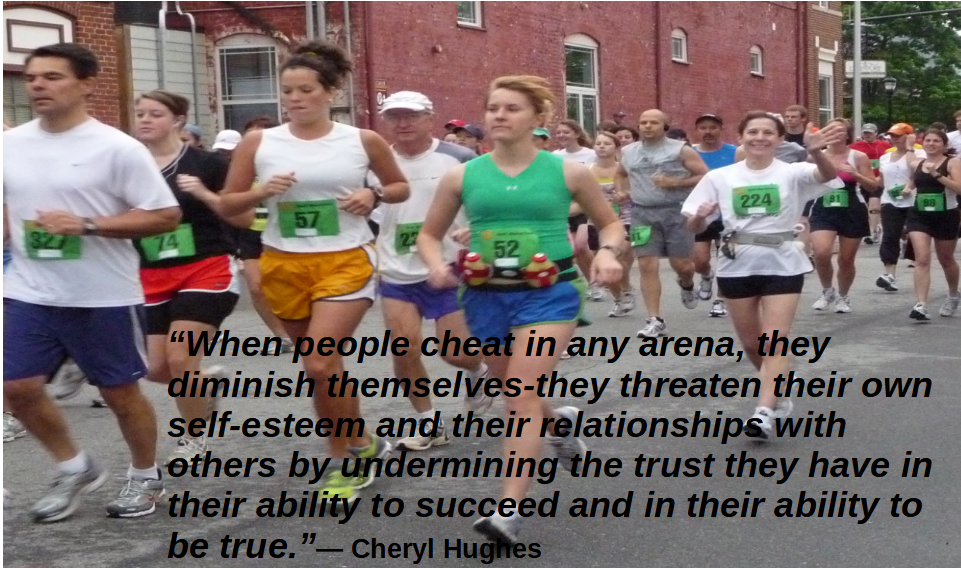
- A runner who cheats by bib-swapping for a qualifying time to enter a limited field race may take the place of an honest runner.
- Course-cutting and bib-swapping affect the overall standings and age-group awards.
- Cheaters can also rob the true winners of their moments of glory.
- Cheating devalues the efforts of those who run the course honestly.
It boils down to integrity. Running with integrity means being consistently honest and showing an uncompromising adherence to the race rules.

Motivation plays a key role in whether a runner acts with integrity or not.
Intrinsic motivation is where the runner wants to reach a high, personal standard for their own satisfaction. These runners are really competing against themselves.
Extrinsic motivation is where the runner is externally motivated and they’re more concerned with the result of their effort, whatever that might be—recognition from friends, a medal, to say that they qualified for an “elite” race or had an extremely fast pace. They’re more concerned with how this impacts other people and what other people think of them.
Jack J. Lesyk, Ph.D., CC-AASP, director of the Ohio Center for Sports Psychology, says that people who are externally motivated—driven by recognition from others—can derive satisfaction from getting a race medal, even if they didn’t earn it. Cheating seems an acceptable way to get what they want.
He goes on to say that if a runner is intrinsically motivated, they would not feel greatly rewarded unless they really earned it. Cheating is not acceptable if a runner’s motivation is to run honestly and to the best of her ability. The “reward” is in being satisfied with her efforts.7
Whether or not runners cheat depends on their integrity and motivation. Only they can decide if cheating will become a habitual behavior or an unfortunate mistake never to be repeated.


